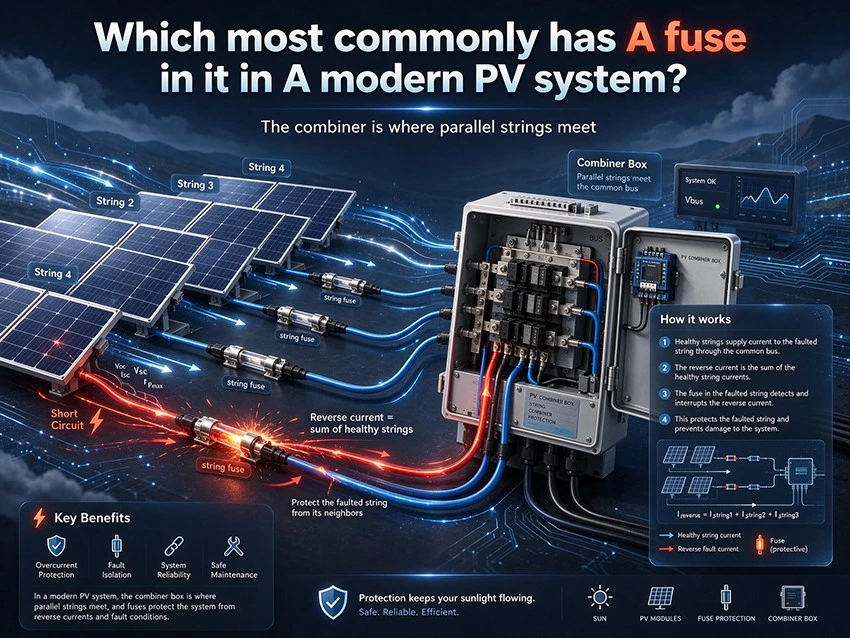
Which most commonly has A fuse in it in A modern PV system?
If you open a modern photovoltaic system and ask where the fuse most reliably lives, the honest answer is not the inverter and not the module junction box. It is the DC combiner box, and the fuse inside it is the string fuse-one per parallel string, sitting between the string's positive conductor and the common busbar. Almost every pre-wired and site-wired DC combiner box ships with fuse holders built into the enclosure, because the combiner is where multiple strings meet and where the reverse-current problem becomes real. I have seen plenty of systems where the combiner box was omitted entirely because the installer ran every string straight back to the inverter, but that is an exception driven by short cable runs and low string counts, not the norm.
The reason the string fuse sits in the combiner box is rooted in a fault mechanism that has no equivalent in conventional AC distribution. When several strings are paralleled, a short circuit in one string turns that string into a load. The remaining healthy strings, still producing at their short-circuit current, feed current backward into the faulted string. That reverse current is the sum of the other strings' contributions. In a combiner with six strings, a fault in one string exposes it to five times the current of a single healthy string. The string fuse is the device that opens before that reverse current cooks the module's bypass diodes or the string cable. The fuse does not protect the inverter. It protects the string from its own neighbors.
The standards draw a line that is easy to remember and easy to misapply. Below three parallel strings, individual string fusing is generally not required, because the maximum reverse current is one string's Isc and most modules can absorb that without damage. At three or more strings, the reverse current from two healthy strings reaches roughly twice Isc, and that is where the module's maximum series fuse rating becomes the binding constraint. NEC 690.9 and IEC 62548 both state the requirement in terms of reverse current versus the module's rating: if the possible reverse current exceeds the module's maximum series fuse rating, string overcurrent protection is required. The fuse sizing follows a multiplier, not a round number. Under IEC, the fuse's nominal current must sit above 1.5 times the string's Isc and below the module's maximum series rating; under NEC, the lower bound is 1.56 times Isc, and the fuse must open at 1.35 times its rating within one hour for IEC or 1.56 times for NEC. For a string with Isc of 10 A and a module maximum series fuse of 20 A, that points to a 15 A or 16 A gPV fuse, and that is exactly the rating you see stamped on the cartridge in a combiner box.
The fuse type matters as much as the location. A gPV fuse designed to IEC 60269-6 is the correct class for string protection, and it is the most common choice in combiner boxes precisely because it is built for the DC arc that has no zero crossing. A gG or AC-rated fuse of the same current will melt, but it may not extinguish the arc, and an arc that sustains inside a combiner box turns a localized string fault into a fire that consumes the enclosure. I have a bias here that I will state plainly: a gPV fuse costs more than a generic cartridge, and that premium is the cheapest insurance in the entire array.
What makes the combiner box the most common fuse location is not just physics but economics. A 1 MW centralized plant uses roughly 400 fuses, and each fuse introduces four contact points when you count the fuse clips and the terminal connections on both ends. That is 1,600 DC nodes in a single plant, and every one of them is a potential high-resistance joint that heats under load and drifts in calibration over years of thermal cycling. The combiner box concentrates those nodes in one accessible enclosure, which is good for maintenance and good for coordination. But it also means the combiner box is the component that fails if the fuse selection was based on current rating alone without checking the DC voltage rating at the array's cold-condition open-circuit voltage. A fuse rated for 1,000 VDC at 25°C may face 1,100 V or more at -10°C, and a fuse that cannot generate enough arc voltage at that cold extreme will not clear the fault it was installed to clear.
The other location where fuses appear is the inverter's DC input, but that is a coordination point rather than the primary string protection layer. Some inverters include internal string fuses, and some rely on the combiner box upstream. The inverter-side fuse is mainly about array output protection and DC input circuit coordination, not about the reverse-current problem that the string fuse solves. When I review a design where the only fuses are at the inverter input and there are no per-string devices in a combiner with four or more strings, I look for the module's maximum series fuse rating and the reverse-current calculation. If the calculation says the module can absorb the reverse current, the design is defensible. If it does not, the inverter fuse will not save the string. It will open after the module has already been damaged.
So the direct answer is that the string fuse in the DC combiner box is the fuse you will find most often in a modern PV system, and the reason is a combination of reverse-current physics, code requirements triggered at three or more parallel strings, and the practical reality that the combiner box is where the strings are consolidated and where the fuse holders are already installed. The fuse is not there to protect the inverter. It is there to make sure that a fault in one string does not turn the other strings into a current source that destroys the faulted one before anyone notices. That is a narrower job than "protecting the system," but it is the job that actually matters in a parallel array, and it is the one the combiner box is built around.